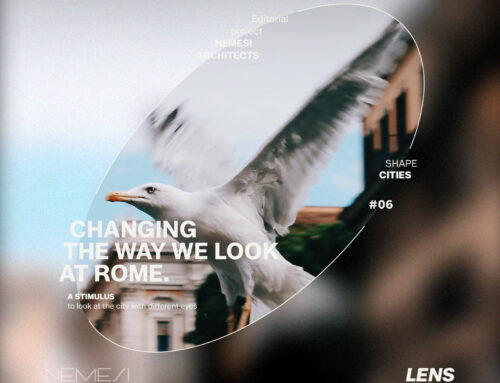
LENS #03
Galleria Borghese — Shape Culture
Rome Beyond Conservation
A conversation between Susanna Tradati and Michele Molè on the expansion of the Galleria Borghese — and on the need for a cultural vision for the Capital
Susanna Tradati: Michele, a few weeks ago I challenged you with a question that arose from the debate over the expansion of the Borghese Gallery. It struck me that such an important issue hadn’t sparked a broader discussion. What surprises me most is how the debate has been reduced to a choice between transformation and conservation, whereas it would make more sense to consider how Rome can move from a culture of conservation to a culture of dialogue between heritage and the contemporary world—don’t you think?
Michele Molè: I believe the problem runs even deeper.
Rome continues to think of its heritage as something to be protected. I, on the other hand, believe that heritage must be continually reinterpreted. The Rome we admire today did not arise from conservation. It arose from transformation. Every era has had the courage to leave its own mark, entering into a dialogue with previous ones.
If the Renaissance had been afraid of antiquity, or the Baroque of the Renaissance, Rome would be a very different city today. That is why I continue to believe that true preservation does not mean standing still.
Genuine preservation means producing quality in the present.
Susanna Tradati: And yet I sense something shifting. The project for the Museo della Scienza, the expanded MAXXI, and then initiatives like Open House, Videocittà, the new private galleries and foundations…
Michele Molè:
I see those signals too. And I think they matter enormously.
For the first time in many years, Rome seems to be reinvesting in culture — not only as memory, but as an engine of urban transformation. The challenge is that we’re still at the beginning.
These are promising signs, but they remain too fragmented, too isolated. They tend to emerge from the vision of individual institutions or individual clients — not yet as part of a broader project for the city as a whole.
And this is precisely where Rome should have the courage to take a leap forward. It’s not enough to have a few excellent cultural venues. We need to build a system.
If we look at other major cities, we see that this transition has already taken place. Over the past few decades, London has built a widespread cultural network ranging from the Tate Modern to the Southbank Centre, integrating museums, public spaces, and contemporary art. Paris has successfully complemented its historical heritage with new cultural hubs, from the Centre Pompidou to the Fondation Louis Vuitton and the Bourse, continually redefining its cultural role.

Fondation Louis Vuitton Paris © Gehry Partners

Tate Modern London, Carsten Höller, Test Site 2006, photo © Tate
Rome could draw inspiration from these experiences, but it must do so by building on its own identity.

Le Dernier Carnaval: Cai Guo-Qiang’s farewell to the Beaubourg before its renovation. Centre Pompidou, Paris © Renzo Piano
Susanna Tradati: This thought brings me back to the ideas we developed for the Torrespaccata area, when we began proposing to Cinecittà and the city administration a project for an integrated cultural system capable of making this place vibrant and recognizable throughout the year.
Michele Molè: Cinecittà is an extraordinary asset for Rome: a place known throughout the world that, despite its symbolic and productive value, is not yet perceived as the heart of a broader cultural hub. With this project, we sought to start right from Cinecittà to build an ecosystem around it capable of connecting the Museum of Cinema and Audiovisual Arts, the Istituto Luce Archive, the Rome Film Festival, public spaces, and the landscape. The idea was to build identity through culture and make Torrespaccata a new urban hub—one of many that I hope will one day become a reality. Rome needs precisely this: a cultural geography composed of a network of spaces distributed throughout the city, capable of interacting with one another and generating knowledge, innovation, urban quality, and new relationships. Culture must become an urban infrastructure.

Torrespaccata Master Plan © Nemesi Architects | Rome, Italy
Susanna Tradati: The same may also be true for archaeology. I’m thinking of the debate over the Imperial Forums complex. I get the impression that heritage and contemporary life are often still presented as two opposing worlds.
Michele Molè: I don’t agree with that contrast. Archaeology is contemporary. It always has been. Every era has reinterpreted what it inherited and built new perspectives upon it.
The problem arises when cultural heritage is separated from the life of the city. The Imperial Forums should not be merely a place of remembrance. They should once again become one of the places through which Rome tells the story of its present, serving as the starting point for routes that traverse the historic center but also extend toward the outlying archaeological sites, connecting to new museums and cultural institutions outside the historic center. Contemporary life does not diminish archaeology. It restores meaning to it.

Pedestrian Walkway for the Markets of Trajan © Nemesi Architects | Rome, Italy
Susanna Tradati: From this perspective, architectural competitions also play a central role, not only in providing concrete solutions but also in fostering a debate on the future of the city.
Michele Molè: Absolutely. In recent years, we’ve participated in the major competitions concerning Rome’s future. Competitions should be the place where a city challenges itself—the place where different visions of the future are compared. Rome needs more competitions. But above all, it needs competitions that have the courage to foster culture, even before producing rankings.
We need to refocus on experimenting with the languages of the contemporary world, overcoming the widespread skepticism about the possibility of producing quality architecture and culture today. Today, there is a risk that the contemporary will lose its legitimacy as a cultural expression of the present. For this reason, we must develop new interpretive tools—new lenses through which to view our times and recognize their value. There is still significant resistance to these ideas. For cultural heritage authorities, but also for numerous cultural institutions, it is not always easy to view contemporary design as an opportunity for dialogue with history rather than as an element of opposition. Precisely for this reason, it is necessary to initiate a broader dialogue capable of overcoming prejudiced positions and bringing a fundamental question back to the forefront:
What legacy of our time do we want to leave for future generations?
Susanna Tradati: Let’s go back to the Borghese Gallery, then. In light of everything we’ve discussed, how do you interpret that competition?
Michele Molè: I believe that this project is about much more than simply expanding the Borghese Gallery. Making the museum more accessible is certainly necessary, but the real challenge lies elsewhere: to demonstrate that our era, too, is capable of leaving a cultured and thoughtful legacy, adding a new layer to Rome’s long history.
That is why this competition represents an important opportunity—not only to reinterpret the role of the Borghese Gallery, but also to strengthen its relationship with the city and spark a broader discussion about Rome’s future.

METAMORPHOSIS, Borghese Gallery, Rome
Susanna Tradati: If you had to sum up Rome’s challenge in one sentence, what would it be?
Michele Molè: Every great era in Rome’s history has had the courage to leave a mark on its time. Our responsibility is not only to preserve that legacy, but to continue building upon it. Because a cultural capital today must continue to produce contemporary culture.
LENS was born out of a desire to put curiosity and mindfulness back at the centre, to broaden our view of the world and continue to talk about beauty and current events, even as our environment — complex and polluted — sometimes seems to be falling apart.